
Sin Cargo: Day 1. Giving away ideas. Today: Basic Fit.
This project started from a simple decision: give ideas to brands that never asked for them. Not because I have time to spare. Because I’ve always had a curiosity I can’t turn off, the one that looks at a brand and sees what it could be doing instead of what it’s doing. Not as criticism. As opportunity.
Every piece in this series starts in the same place: an observation. Something I saw, read, or heard that made me think there was more there.
This one started with a LinkedIn post by Teresa Castillo Erustes.
Teresa wrote something that probably everyone in Madrid has thought at some point: no matter the line, the day, or the time, there’s always a Basic Fit backpack on the metro. Her take was that this is brilliant marketing: a brand circulating through the city every day, organically, without looking like advertising.
She was right. Completely.
And yet I couldn’t stop thinking about what wasn’t being said.
I mentioned Coca-Cola. How they’ve been doing something similar for years, giving away chairs, tables, and umbrellas to bars and restaurants, but with one key difference: Coca-Cola takes that experience to places that make sense for the brand, and those places end up in YouTube videos and Instagram photos with millions of views. The Basic Fit backpack circulates, yes. But then it does nothing more than exist. It just sits there, passive. The brand’s most distributed asset, sleeping.
Teresa agreed, guerrilla marketing on public transport, she said, sounded like something that could really work.
And I couldn’t let go of the question: the backpack already made it everywhere. Now what?
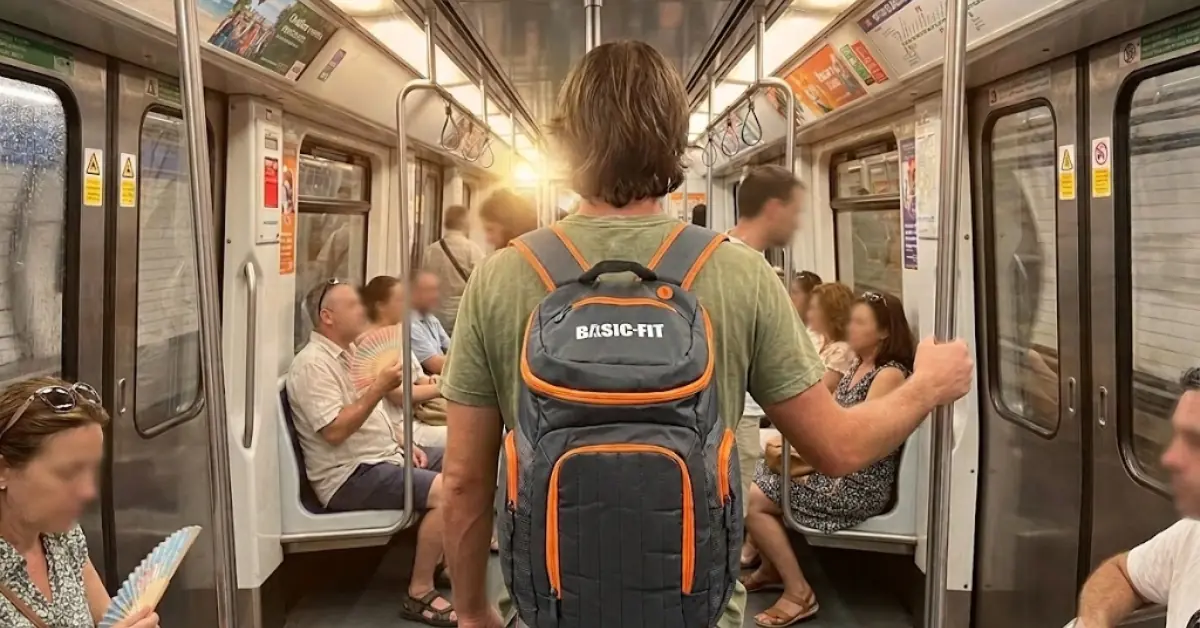
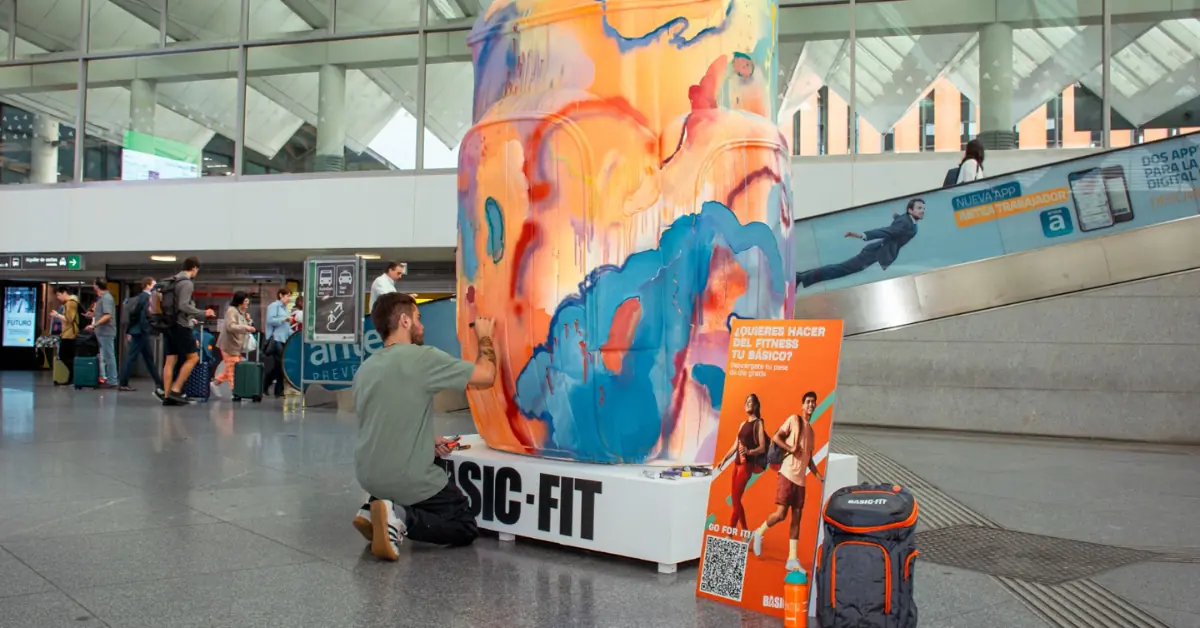
Teresa’s post wasn’t an isolated observation. In 2025, three major Spanish media outlets published analyses of the same phenomenon. Directivos y Gerentes called it “a low-cost brand strategy” and documented how the backpack had gone from a promotional gift to urban landscape. El Economista had covered a 2024 installation in Atocha (a three-meter replica of the backpack with a QR code giving access to a free day at any club). And Libertad Digital went further and interviewed Basic Fit Spain’s marketing manager, Romain Bisiach, who confirmed what everyone was seeing: “the backpack has become an emblem recognized across the country” and “gives us visibility as effective advertising.”
Basic Fit knows they have something. They’ve known it since 2021, when they started giving a backpack to every new member on day one. They know because the media writes about it, because branding experts analyze it, because they themselves celebrated it with an installation at Spain’s busiest train station.
And yet, with all of that on the table, the backpack still does nothing more than exist.
That’s what I find interesting. Not the asset itself. The distance between recognizing it and activating it.
The latent asset
Since 2021, every new Basic Fit member receives a backpack on day one. With over 4.5 million members across Europe and 223 clubs in Spain alone, the number of backpacks in circulation is, as Directivos y Gerentes noted, literally incalculable.
There’s even a name for what happens when someone starts noticing the backpack: frequency illusion. Branding expert Fernando de Córdoba explained it in that same article: once you notice it once, you start seeing it everywhere, not because there are more, but because your brain starts registering them.
Bisiach himself summed it up for Libertad Digital: “the idea for the backpacks simply came from wanting to make it easy for our members to start their fitness routine from day one. That combination of utility and visibility let us see it could become a successful strategy.”
Utility plus visibility. That’s what they have. And it’s enough for a first phase.
The problem is that Basic Fit has been in the first phase for four years.
The backpack circulates, creates frequency illusion, shows up on metros, at airports, in supermarkets. But it communicates nothing beyond the logo. It does nothing with the moment someone is wearing it. It doesn’t turn that presence into a conversation.
Coca-Cola didn’t settle for having chairs exist on terraces. They made them unmistakable and photographable. The difference isn’t the object. It’s what the object does when it’s out in the world.
The cultural tension
Rucking (walking with a loaded backpack) is one of the fastest-growing workouts of the last two years. It comes from military culture, was adopted by the fitness world, and now shows up on every health podcast and functional training account. The reason is simple: it requires no extra time. It happens during what you’re already doing.
That intersects with a broader movement: fitness integrated into daily life. People don’t want to go to the gym more days. They want to move more without rearranging their schedule. “Gym snacks” (small doses of movement spread throughout the day) are growing for exactly that reason.
The Basic Fit member heading to the metro with their loaded backpack is already rucking. They just haven’t been told.
The constraint
Basic Fit has been doing what every other brand in the category does for years. “Power your attitude.” “The club that suits you.” Messages about physical and mental wellbeing, exercise as a habit, the gym as a space for personal improvement. Well executed. Consistent with their brand.
The problem is that it’s exactly what every fitness chain in Europe is saying.
The real constraint isn’t tone or creative ambition. It’s differentiation. When an entire category speaks the same language, one more voice in that conversation doesn’t add, it disappears. Basic Fit can’t win the motivation battle against Nike, Adidas, or premium gyms with five times their media budget. If they try to compete on that ground, they lose.
What they can win is a territory no competitor has claimed: fitness that already happens without anyone asking for it. Not the gym as a destination, but movement as an invisible habit. The difference isn’t in encouraging you to go to the gym. It’s in recognizing you when you’re already doing it without realizing it.
No competitor looks outside the gym because that would require admitting that a workout can happen somewhere else. Basic Fit, with its backpack already inside that daily life, is the only brand in a position to say so.
The activation
“You’re already working out. Nobody just hadn’t told you.”
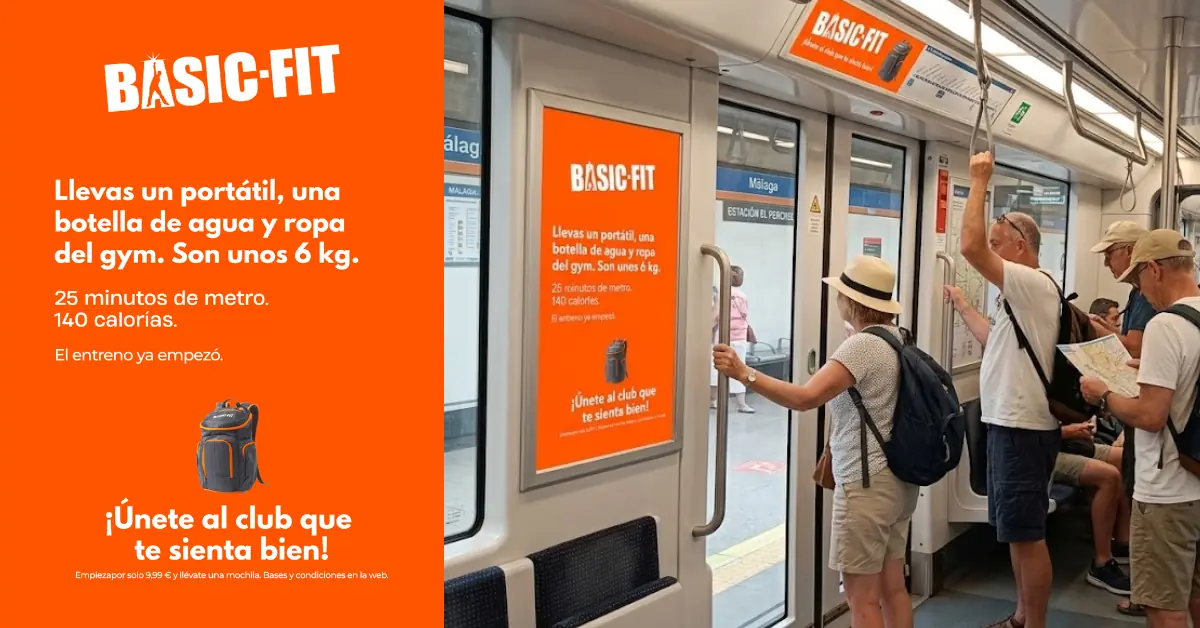
Stickers on the handrails and standing areas of metro carriages. With a calculated stat based on what people already carry in their bag: the one-liter bottle, the laptop, the gym clothes, the books. No new products. Nothing to buy. Everything that adds weight is already there.
“Laptop, water bottle, gym clothes. 6 kg. 25 minutes on the metro burns around 140 calories. Your workout already started.”
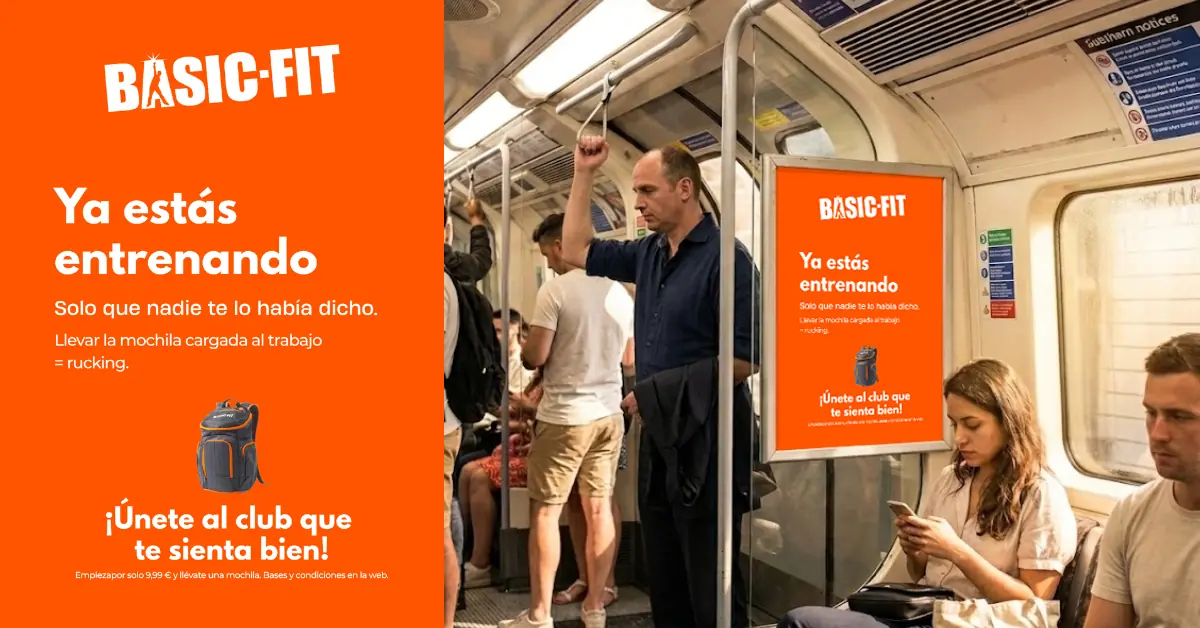
Sticker designs shown in Spanish (copy translation above).
The calculator also lives in the app. You select what you’re carrying today and the app tells you how much you’ve already worked out before reaching the office. The result is shareable.
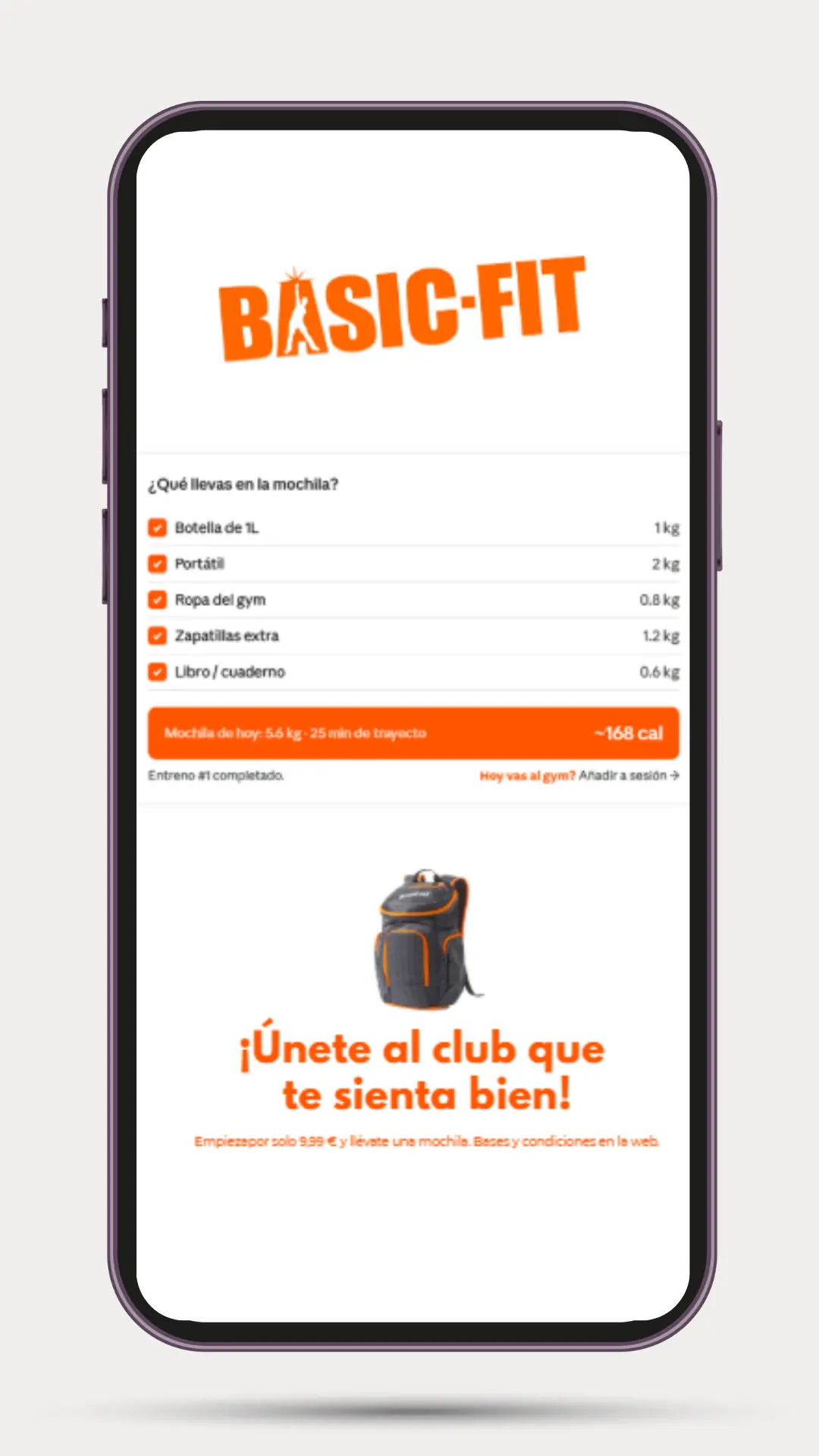
This isn’t a media campaign. It’s activating what already exists, in the exact context where it already exists.
Why it gets shared
The mechanism is identity validation.
The brand gives the user a frame to talk about something they already did. It doesn’t ask them to do something new. The sticker on the metro handrail is the content. The photo already exists. The person who sees it, photographs it, posts it, and writes “literally me every day” is already generating what Basic Fit needs.
The difference from an influencer campaign is that this doesn’t look like advertising. It looks like someone discovered something. And when something looks like a discovery, it gets shared.
Basic Fit already has proof that their objects in the world generate organic content: the Atocha installation, the TikTok memes, the LinkedIn posts. The backpack already proved it can be the protagonist. It just needs something to say.
The next step
If this sparked an idea and you want to explore it, I'd like to hear from you. These pieces are designed to turn into something concrete, not stay as analysis. If you work at an agency or a brand and see a way to take it further, get in touch. LinkedIn or by email.