
Side Quest Job — How I turned frustration with the job market into a free AI tool
Every week I see people with years of real experience sending CVs into the void. It's not lack of talent. It's a hiring system that decides who gets to prove what they know before they ever get the chance.
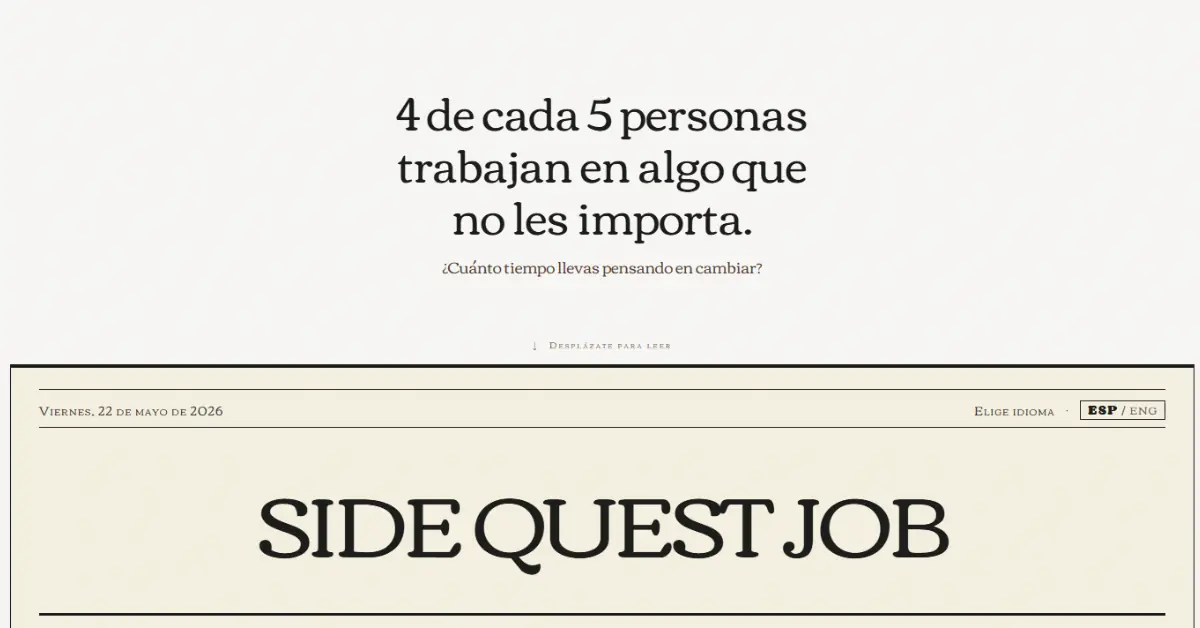
There was a problem everyone saw
and nobody was solving well
I lived it for years with colleagues. I see it every week on social media.
Someone studied, built experience, knows how to do their job well. But companies ask for profiles that don't exist: five years of experience in a technology that's three years old, three different roles packed into one, and if you don't fit the mold exactly, you get the same template email that another thousand candidates received that same day.
The system isn't evaluating talent. It's filtering profiles. And most people with real skills (the ones who could solve specific problems for specific companies) never get to demonstrate what they can do.
There's a second problem, less visible but just as real: those same people don't know exactly what they could do outside their current job. They have skills, knowledge, contacts who constantly ask for their help. But they lack clarity about how to turn all of that into something concrete and monetizable.
The question I asked myself,
and the bet I decided to make
If AI tools can analyze a professional profile and detect patterns we can't see ourselves, could I use them to help someone discover what they can do with what they already have?
Not to find a job. To skip the filter entirely.
The hypothesis was this: if you give a language model the real context of a person (their work, their skills, what people ask of them, what they enjoy), it can return business or income ideas that person would never have considered, but that make perfect sense for them specifically.
The bet was to build it free, with no sign-up, so anyone could use it in under ten minutes.
The experience I designed:
how someone lives it from the first click
You enter without signing up. No personal data form. No friction.
The first thing you see is a short form that asks things you already know: what you do for work, what skills you have, what you're passionate about, what people in your circle ask for your help with, what goal you're pursuing. There's also a RIASEC profile (six dimensions of professional personality) that adds a layer of precision to the analysis.
In under two minutes, the AI analyzes that profile and returns three business or income ideas tailored specifically to you. Not generic. Not the same for everyone. Three proposals built on what you already have and already know how to do.
That's where the part I spent the most time designing begins: the idea lab. For each idea, you can go deeper through ten guided steps. The AI helps you validate the market, define your ideal client, build your value proposition, set a price, identify your first potential client, and map out the first concrete steps. Each step builds on the previous one.
The experience is designed so that moving forward feels natural. No endless pages or complicated menus. It's a structured conversation that takes you from "I have a vague idea" to "I have a plan I can start tomorrow".
What it produces:
the concrete result you walk away with
When you finish the lab, you receive a downloadable report with a complete analysis of your idea across 10 modules:
- Startup validator: risk analysis specific to your profile, your strengths as a founder, and an honest verdict on whether you should launch
- Niche finder: 7 additional micro-niches beyond the 3 initial ideas, with criteria for choosing which one fits you best
- Pain researcher: the real problem your clients would pay to solve, the most common objections, and the exact phrases they use when they have it
- Lean Startup plan: value proposition, ideal client profile, acquisition channels, revenue model, and a week-by-week plan for the first 30 days
- MVP designer: the simplest version you can validate in 7 days, with the exact tools to build it alone
- Organic acquisition: a customer acquisition strategy without paid advertising, with a first-contact script ready to use
- Monetization: pricing structure, three service tiers, and income projections at 3, 6, and 12 months
- Toolkit: the complete stack to operate the business, with the 5 tools to install this week
- 90-day roadmap: the 3 priority skills to develop and what you explicitly should not learn yet
- Premortem analysis: the 5 most likely reasons for failure for your specific profile, with warning signs and a contingency plan for each one
Side Quest Job doesn't give you inspiration. It gives you a complete diagnosis of your idea so you can make real decisions.
How it was built:
the tools that made moving fast possible
The interface runs on React 18 with TypeScript, using Vite as bundler and Tailwind CSS for design. The animations that accompany each step of the analysis are implemented with Framer Motion, forms with React Hook Form, and validation with Zod.
The AI system works in cascade: if Groq hits its limit, OpenRouter takes over, and if that also fails, Cloudflare Workers AI closes the loop. The user notices nothing. Before processing any input, a moderation system via LLM analyzes the content to ensure it's appropriate (fail-open: when in doubt, process). The prompts and business logic live in Cloudflare Pages Functions and never reach the browser.
The entire development was orchestrated with Claude Code, from the initial architecture through code, debugging, deployment, content, and copywriting. What would normally take weeks was compressed into days of actual work.
What the numbers show
since it went live
Launched: May 2026 · Real usage metrics coming soon.
Where it stands now
and what it proves is possible to build
Side Quest Job is in production, free, and available to anyone who wants to discover what they can do with what they already know.
The project proves that today it's possible to go from an observation about a real problem to a functional, bilingual, AI-integrated product deployed globally, without a team, without months of development, with the right tools.
If you have a problem in your business that could be solved with a similar tool, there's probably already a way to build it. The question is whether someone has seen it.