
L.E.M.O.N.S. Framework — The method that forces you to think what you don't want to think, before you decide
I've always enjoyed learning new things, experimenting, and turning what I learn into something others can use. This project was born from that: I took two ideas I found genuinely valuable, combined them, and built a tool that I hope helps you decide better.
Two interests that
had nothing to do with each other
I've always enjoyed learning things that are actually useful and pushing them until I really understand them. Mental models hooked me that way: thinking frameworks that, properly applied, let you see what others miss and avoid the mistakes that cost the most.
The book that changed how I think the most is Poor Charlie's Almanack, the collection of Charlie Munger's thinking, Warren Buffett's partner for decades. It's not about investing. It's about how to reason without deceiving yourself. How to build a worldview that holds up against reality.
The second interest was Pip Decks: physical cards where the format does the work that willpower doesn't. Each card forces you to consider an angle you'd otherwise ignore.
One day I connected the two: what if Munger's mental models lived in a card deck focused specifically on decisions? That's how L.E.M.O.N.S. started.
The real problem isn't
lack of information
Most important decisions are made poorly. Not for lack of intelligence or data, but because our brain is wired to confirm what it already believes and avoid the discomfort of genuine analysis.
When you have to decide whether to launch something, accept an offer, invest, or make a major life change, what typically happens is this: your head already chose, and what you call "thinking" is actually finding reasons to justify what you already decided. You're not evaluating. You're rationalizing.
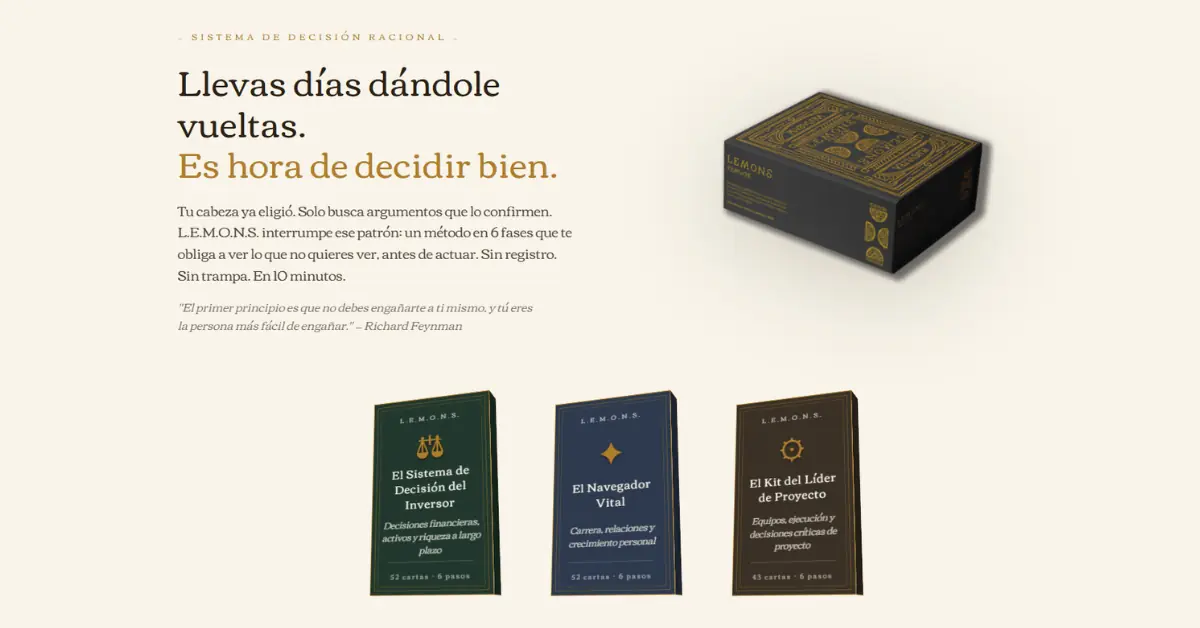
L.E.M.O.N.S. interrupts that process. It forces you through six distinct lenses before you act: List the Reality, Examine your Flaws, Measure the Impact, Overcome Objections, Name your Mission, Strike while the Iron is Hot. Each phase has its own cards. Each card asks a question you'd rather not answer.
L.E.M.O.N.S. doesn't tell you what to decide. It stops you if you don't know why you're doing it.
How it works:
three decks, six phases, one final adversary
The system has three decks based on the type of decision you're facing: the Investor deck (finances, assets, long-term wealth), the Life deck (career, relationships, personal growth), and the Projects deck (teams, execution, critical decisions).
There are two game modes. The Quick Filter (10 minutes) draws six random cards, one per phase, and guides you through them in order. Cards appear face-down and you flip them one by one. The Full Analysis (25–35 minutes) lets you choose cards in each phase and ends with the Shadow Board: five archetypes representing the internal voices that block change, each with its own specific attack.
If your decision survives the Board, it comes from conviction. If not, you have valuable information about why you're not ready yet.
The Shadow Board:
the part that was hardest to design
The final adversary in the Full Analysis is a system of internal opponents. Not external characters — archetypes of the parts of you that society, your fears, and your history have built to keep you where you are.
The Inner Critic. The Cynical Realist. The Guardian of the Status Quo. The Identity Saboteur. The Cost Counter.
Each one asks a question designed to make you doubt. If you answer them honestly and your decision holds, that's the clearest signal that you're acting from conviction, not impulse or external pressure.
It's the part of the project I like most. Not because it's complicated, but because it's uncomfortable in the right way.
Why a single HTML file
and not an app with a login
I had two options: build an app with a database, user accounts, decision history, and all the features that stack implies. Or build a single HTML page that works without a server, without sign-up, without personal data.
I chose the second without hesitation. Not because it's easier (it isn't, really), but because it's more honest about what I wanted to build.
L.E.M.O.N.S. is a reflection tool, not a data product. I don't need to know who you are or save your decisions. What you need is a space to think without friction. You come in, think, leave. No trace.
The result is an HTML file under 200KB that works offline, on any device, with no external dependencies other than the typeface.
What it has
Launched: June 2026
There's a decision pending.
You've waited long enough.
A useful tool doesn't need to be complex. L.E.M.O.N.S. works because the questions are uncomfortable in the right way, the flow takes you where you don't want to go, and the card format creates just enough distance between you and your own bias.
The best products sometimes come from connecting two things that don't seem related. Munger and Pip Decks. Analytical rigor and game mechanics. The result is something you use in ten minutes that changes how you see a decision you've been avoiding for weeks.
If you have something pending, try it now. In ten minutes you'll know whether the problem is lack of information or lack of honesty with yourself. And that difference changes everything.